How A Cricket Pitch Is Prepared, Rolled And Read
A pitch is a manufactured object. It is built over a week or more from soil, water, grass and weight, and almost every characteristic a commentator describes on the first morning was decided days earlier by a groundsman with a hose and a roller.
What A Square Is Made Of
The strip is clay based soil, and the clay content is the single most important variable. High clay soils bind tightly as they dry and produce a hard surface that holds together for days. Low clay soils break up sooner, which is why some grounds turn square on day three and others never do.
On top of that sits grass, and the amount left on the surface is the groundsman’s main lever. Grass holds the surface together and offers the seam something to grip; a bare surface dries faster, cracks sooner and favours spin as the match goes on.
The Week Before A Match
| Stage | What Happens | Effect On Play |
|---|---|---|
| Heavy watering | The strip is soaked through | Sets up a hard base once dried |
| Drying | Water is allowed to leave from the top down | Determines how deep the moisture sits |
| Rolling | Weighted rollers compact the surface | Pace and even bounce |
| Mowing | Grass cut to the chosen length | Seam movement and durability |
| Final roll | Light roll on the morning | Binds the top for the first session |
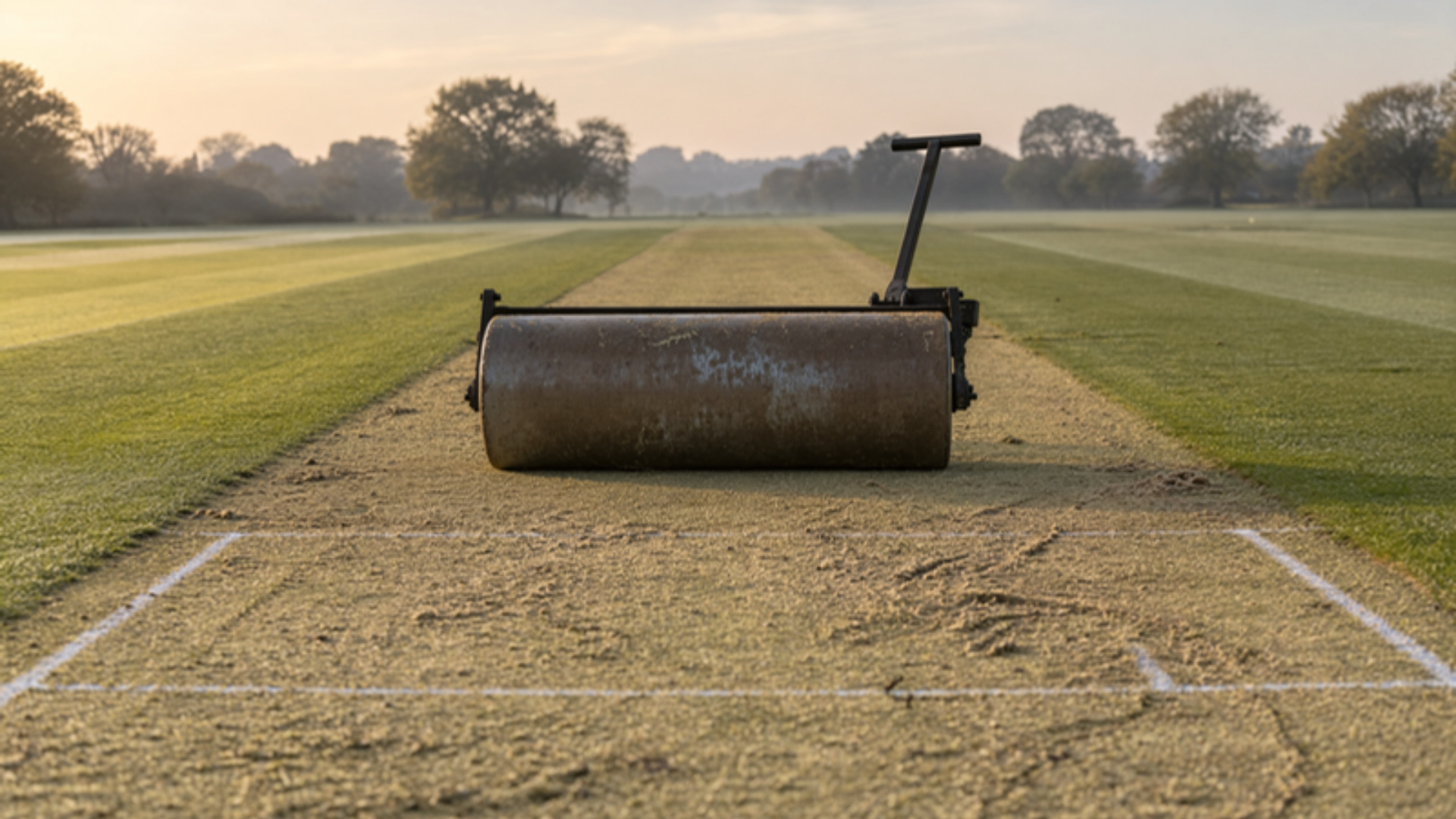
Rolling is the part most often misunderstood. The roller does not flatten a pitch so much as squeeze the moisture into a consistent layer and bind the particles together. Rolling a wet strip drives water down and leaves the top soft; rolling a dry strip simply loosens the surface. The window in which it works is narrow.
Reading A Pitch Before Play
Four things can be assessed from the boundary edge without touching the surface at all.
| What To Look At | Reading |
|---|---|
| Colour | Dark means moisture; straw means dry and likely to break up |
| Grass cover | Even green cover means seam; patchy or bare means spin later |
| Cracks | Visible cracks on day one mean uneven bounce by day three |
| Footmarks from previous use | Rough outside the line is a target for spin |
| Sheen in low light | A glossy look means surface moisture still present |
The grass reading is the one people get backwards most often. Green does not automatically mean the ball will seam all day. A thin, even covering of living grass holds moisture and helps the seamers in the first session; a thick mat of dead grass does very little except slow the ball down.
How A Pitch Changes Across A Match
On day one the surface is at its most bound and its most predictable. Over the following days the top dries, the binding weakens, and the surface starts to break at the points of greatest stress, which are the bowler’s footmarks and the length area where the ball repeatedly lands.
Bounce becomes uneven before turn becomes dangerous. A ball landing on a hard patch sits up, the next landing an inch away in a soft patch keeps low, and the batter has no way to tell which is coming. That is what makes a fourth innings chase difficult, far more than the amount of spin on offer.
The useful question about a worn pitch is not how much it is turning. It is whether the bounce is still even. A pitch that turns a lot but bounces consistently is playable; one that turns a little and bounces unevenly is not.
What A Groundsman Is Actually Asked For
A pitch is prepared to a brief, and the brief varies by format and by the home side’s intentions. A five day surface needs to survive five days without becoming dangerous. A twenty over surface needs to be flat, true and fast from the first ball, because nobody is interested in a low scoring game that finishes in three hours.
The same square can produce both, which is the point. The variables are mostly water and rolling time, not the soil underneath. How those surfaces then interact with the ball is covered in the piece on the three Test ball types, and the conditions a captain cannot control at all are in the article on dew.
The Difference Between A Poor Pitch And A Difficult One
A difficult pitch is one where good play is rewarded and poor play is punished more harshly than usual. A poor pitch is one where the outcome stops depending on the quality of the play at all, because the bounce has become unpredictable enough that a good defensive stroke is no safer than a bad one.
The line between them is the consistency of the bounce rather than the amount of help on offer. A surface that seams all day and bounces evenly is difficult and perfectly fair. A surface that does very little except occasionally shoot along the ground is poor, even though it looks less dramatic.
What Groundstaff Can And Cannot Fix Mid Match
Between days, a square can be swept, lightly rolled and covered. None of that restores moisture to a surface that has dried out, and nothing can reverse the breaking up of the top layer. The roller can temporarily press loose material back into place, which is why a pitch sometimes plays better on the morning of day four than it did at the end of day three, and worse again by lunch.
Which is the whole argument for batting first on a surface expected to deteriorate: the resource being spent is not just runs but the condition of the surface itself. How a captain decides to spend it is covered in the article on declarations, and the ball that has to work on it in the comparison of the three Test balls.