 Highveld Cricket
Long Reads On The Finer Points Of Cricket
Highveld Cricket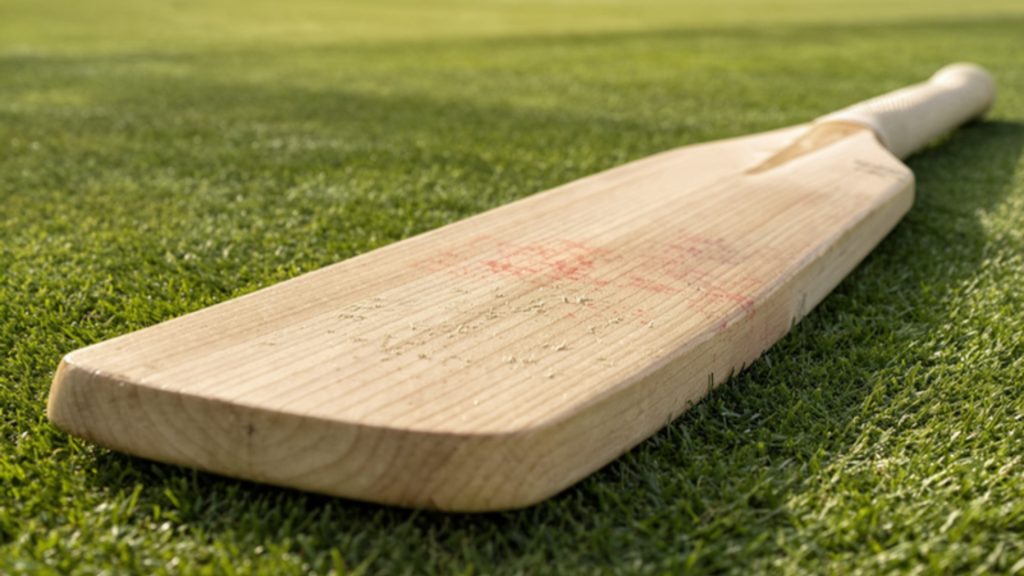 Equipment
The Laws cap the geometry of a bat but not its weight, and from October 2026 they allow a kind of bat that was illegal in adult cricket for a century.

Most of what decides a cricket match is settled before anyone watching notices. The soil under the pitch, the stitching on the ball, the thickness of a bat edge, the humidity after sunset, the wording of a Law that was rewritten in October. None of it appears in the highlights, and all of it changes the result.
This desk works through those parts slowly, one at a time, with the current wording of the Laws rather than the version people remember. Each section below points into a longer piece.
A new edition of the Laws took effect on 1 October 2026, and several of the changes affect moments that used to produce arguments on the field. The most consequential is a rewrite of what counts as the ball being finally settled.
| Law | What It Now Says |
|---|---|
| 20.1.1.1 | The ball no longer has to reach the bowler or keeper to be finally settled. Any fielder may hold it, or it may be stationary on the ground. |
| 12.5.2 | A wicket no longer ends the final over of a day. The over is bowled in full if conditions allow. |
| 18.5 | Batters may turn back from a run without penalty, and the fielding captain now chooses who takes strike next. |
| 19.5.2 | A fielder who has been outside the boundary may touch the ball in the air once, then must land wholly inside. |
| 19.8 | An overthrow is an attempt to direct the ball at the stumps. A misfield is not an overthrow. |
| 27.3.1 | A keeper may have gloves level with or in front of the stumps during the run-up, and must be wholly behind only after release. |
| 5.8 | Laminated bats of up to three pieces of willow are now legal in open age cricket, at each board’s discretion. |
Two more are about control rather than geometry. A catch or run out now requires the ball to be genuinely held with complete control, defined as the fielder being able to keep it as long as they liked and dispose of it as they chose. Touching the hand is not enough. The full treatment is in the piece on the dead ball law.
An LBW decision is a checklist worked through in a fixed order, and the umpire stops at the first question that produces a not out. Disagreements almost always come from skipping a step rather than from judging one differently.
| Order | Question | Not Out If |
|---|---|---|
| 1 | Was it a legal delivery | It was a no ball |
| 2 | Where did it pitch | Outside leg stump |
| 3 | Where did it strike the batter | Outside off, with a shot offered |
| 4 | Did it hit the bat first | There was an inside edge |
| 5 | Was it going on to hit the stumps | It was missing |
The exception that catches people is the third question. A batter who offers no shot can be given out even when struck outside the line of off stump, which is what stops batters padding away deliveries they never intended to play. Worked through in full in the article on LBW.
Test cricket is played with three different balls depending on the country. India uses SG. England, Ireland and the West Indies use Dukes. Everywhere else uses Kookaburra. Every limited overs international anywhere uses a white Kookaburra, which is why the one day game travels far better than the five day game.
| Ball | Stitching | Behaviour |
|---|---|---|
| Dukes | All six rows hand stitched | Moves for longer, seam stays proud |
| SG | All six rows hand stitched | Pronounced seam, grip for spinners late |
| Kookaburra | Two inner rows by hand, four outer by machine | Swings hard and early, then goes quiet |
That single difference drives selection as much as the pitch does. A Kookaburra attack needs genuine pace to find something once the swing has gone; a Dukes attack can carry a medium pacer who moves it off the seam for forty overs. Set out in the comparison of the three Test balls.
Law 5.7 caps the geometry of a bat but says nothing about its weight. A bat may be as heavy as a player can swing; what it may not be is deeper or thicker at the edge than the limits allow, because depth and edge thickness are what turn a mishit into six.
| Dimension | Limit |
|---|---|
| Overall length | 38 in, 96.52 cm |
| Blade width | 4.25 in, 10.8 cm |
| Blade depth | 2.64 in, 6.7 cm |
| Edge thickness | 1.56 in, 4.0 cm |
The width figure dates from the eighteenth century. The depth and edge limits arrived in October 2017, after a study by Imperial College London found that lighter pressing was letting makers put far more wood behind the hitting area at the same overall weight. From October 2026 the Laws also permit laminated bats in adult cricket, a change driven by the cost of English willow rather than by performance. Covered in the piece on bat size limits.
A pitch is a manufactured object, built over a week from soil, water, grass and weight. Almost everything said about it on the first morning was decided days earlier by a groundsman deciding how much water to put in and how long to roll.
| What To Look At | What It Usually Means |
|---|---|
| Dark colour | Moisture still in the surface, seam movement early |
| Even thin grass | Holds the surface together, helps the seamers |
| Straw colour and bare patches | Dry, will break up, spin later |
| Cracks visible on day one | Uneven bounce by day three |
| Footmarks outside the line | A target area for spin in the second innings |
The reading people get backwards most often is grass. A thin, even covering of living grass holds moisture and helps the bowlers in the first session. A thick mat of dead grass does almost nothing except slow the ball down. More in the article on preparing and reading a pitch.
A difficult pitch rewards good play and punishes bad play harder than usual. A poor pitch is one where the result stops depending on the quality of the play at all, because a good defensive stroke has become no safer than a bad one.
The line between them is the consistency of the bounce, not the amount of help on offer. A surface that seams all day and bounces evenly is difficult and entirely fair. One that does very little except occasionally shoot along the ground is poor, even though it looks far less dramatic on television. Bounce goes before turn does, which is why fourth innings chases fail more often to a ball that keeps low than to one that rips.
Dew is the only condition in cricket that gets worse in a predictable direction. Cloud comes and goes and light fades gradually, but dew arrives after sunset, builds through the evening and does not reverse. That predictability is why the toss at a day night match is usually decided before anyone has looked at the pitch.
| What Gets Wet | Effect |
|---|---|
| The ball | No grip, so less spin and less seam |
| The outfield | Faster, the ball skids to the rope |
| The run up | Footing less certain, pace drops |
| Fielders’ hands | Slippery takes and throws |
Which produces the apparent contradiction that captains bowl first at dew prone venues even though dew helps the side batting second. Choosing to bowl is choosing to bat second: you take the harder bowling conditions yourself and hand your batters the easier ones. Set out in the piece on dew and the toss.
The Duckworth Lewis Stern method rests on one idea: a batting side holds a stock of resources, and that stock depends on overs remaining and wickets in hand together. Scale a target by overs alone and you get the absurd results that the method was built to replace.
Read a resource table and the point becomes obvious quickly. Losing ten overs with all ten wickets standing costs a side roughly a tenth of its resources. Losing five wickets costs far more than losing ten overs. Any method that ignores wickets will get interrupted matches wrong, and every method before this one did.
The table is empirical rather than theoretical: it describes how sides actually score, which is why it has to be refitted as scoring behaviour changes. That is what the Stern revision did, and why nobody should expect a final version. Worked through in the article on the method.
A declaration is the only moment in cricket when a captain voluntarily stops scoring runs. It exists in one format and nowhere else, and it forces him to state publicly how many runs he thinks are enough and how long he thinks it will take to bowl a side out.
Every declaration trades two quantities that move in opposite directions. One more over of batting is one fewer over of bowling, and the captain is looking for the point where the next run is worth less than the next over. The working assumption most of them use is that bowling a side out takes around ninety overs on a good surface and rather fewer on a worn one.
| Situation | What Usually Happens |
|---|---|
| Large lead, two days left | Declare early and back the attack |
| Large lead, one session left | Declare only if the surface is breaking up |
| Moderate lead, poor forecast | Declare early, the draw is the real opponent |
| Moderate lead, flat pitch | Bat on and remove the chance of defeat first |
The asymmetry of criticism explains the caution. A captain who declares late and draws is criticised for a session; one who declares early and loses is criticised for years. More in the piece on declarations.
Five sections cover almost everything this desk writes about, and a piece that fits none of them usually means the idea needs more work rather than a sixth category.
| Section | What Goes There |
|---|---|
| Laws And Umpiring | How the Laws are written and what the umpire is actually deciding |
| Conditions | Pitch, weather, dew and light, and how each one moves during a match |
| Equipment | Bats, balls and the manufacturing changes that shifted the balance |
| Formats | What changes between five days and twenty overs |
| Numbers | Scoring systems and rain calculations, worked through in plain language |
Three pieces between them cover most of what makes a match turn, and they are the ones to read first.
More of what gets blamed on pitches is actually the ball. Understanding why a Kookaburra goes quiet after twenty overs and a Dukes does not explains a great deal of why touring sides struggle, and it takes ten minutes. Dukes, SG and Kookaburra, compared properly.
Once you can read a pitch from the boundary you can predict most of the first session before a ball is bowled, and you can tell a difficult surface from a poor one, which commentators frequently cannot. How a cricket pitch is prepared, rolled and read.
Pick the dead ball law rather than a glamorous one. It is the quietest Law in the game and it settles more arguments than any other, because almost every incident that produces an hour of television debate is underneath a question about whether the ball was live. The dead ball, and what changed in 2026.
Laws are quoted from the current edition rather than the one in force when a famous incident happened, which matters more than usual this year given the number of changes that took effect in October. Where a figure can go out of date, the date it was last checked appears in the piece itself rather than in a footnote.
Where something is genuinely disputed, the dispute is described rather than resolved. Cricket has several questions with no settled answer, and writing as though they have one would be worse than saying so plainly.
Nothing in the list above belongs to one format. What changes is how much each variable is worth, and that reweighting is most of what people mean when they say a player is a specialist in one form of the game.
| Variable | Five Days | Fifty Overs | Twenty Overs |
|---|---|---|---|
| Surface deterioration | Decisive by day four | Minor | Irrelevant |
| Ball condition | Central, across 80 overs | Matters for 20 | Barely a factor |
| Dew | Rare, day matches | Often decisive | Often decisive |
| Boundary size | Moderate | High | Very high |
| Rain calculations | None, time is lost instead | Central | Central |
| Declarations | The key decision | None | None |
The clearest example is the ball. Across eighty overs its changing condition is the main engine of a Test innings, which is why reverse swing and the second new ball structure entire sessions. In a twenty over innings the ball barely has time to change at all, so the contest moves almost entirely to field settings and boundary dimensions.
The Laws specify the pitch, the ball and the bat to the millimetre, and say almost nothing about the size of the playing area. Boundary distances fall within recommended ranges rather than fixed dimensions, and those ranges are wide enough that two grounds hosting the same fixture can offer meaningfully different cricket.
A short straight boundary turns a mishit into six and makes a spinner expensive before he has bowled a bad ball. A long square boundary rewards the batter who can run and penalises the one who only clears the rope. None of this is in the scorecard, and almost none of it is discussed before a match, yet it moves scoring rates more than most of the equipment regulations that get argued about at length.
The asymmetry is odd when you set it beside the bat debate. A great deal of effort went into capping edge thickness at forty millimetres, while the distance a ball has to travel to score six remains a matter of local arrangement. Both move the balance between bat and ball; only one of them is written down.